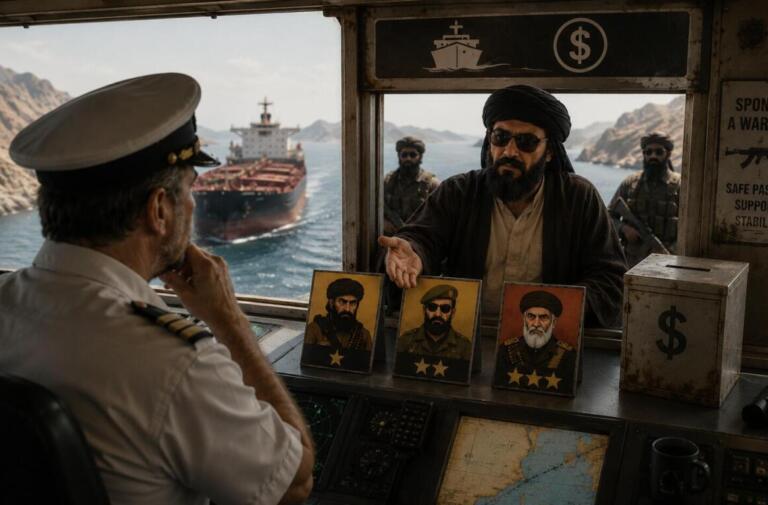


STRAIT OF HORMUZ — Seeking to reassure jittery global markets and several oil tankers currently reversing course at full speed, the Defense Department announced Thursday that Iranian mines scattered throughout the Strait of Hormuz are “clearly marked” by helpful indicators including floating debris, columns of fire, and the occasional secondary explosion.
Pentagon officials emphasized that while the situation may appear chaotic to the untrained eye, particularly the burning tankers, drifting wreckage, and dense plumes of black smoke visible from space, experienced captains should have little trouble identifying hazardous areas.
“Look, we want people to understand this is a very manageable environment,” said a Pentagon spokesperson while gesturing toward a large satellite image showing the narrow waterway dotted with flaming wreckage. “Any area with debris, fire, or large shockwaves in the water is almost certainly where a minefield is located. That’s your visual cue to steer slightly to the left.”
According to defense officials, the debris field created by earlier explosions has effectively formed a “natural warning system,” guiding ships away from the most dangerous portions of the strait.
“In many ways, the system is self-organizing,” the spokesperson explained. “When a mine detonates under a tanker, it produces a large plume of water, flames, and broken hull fragments. Those fragments float around and act like little markers saying, ‘Hey, maybe don’t go here.’”
Officials also released new navigation guidance advising captains to watch for subtle environmental signals such as sudden geysers of seawater, burning fuel slicks, and the sound of frantic radio transmissions.
Energy markets responded nervously to the announcement, with traders noting that roughly a fifth of the world’s oil supply normally passes through the strait.
Still, Pentagon officials insisted the waterway remains open for business.
Added the spokesman, “As long as ships remain alert, avoid fire, and steer clear of exploding objects, there’s no reason this can’t continue operating like a perfectly normal international shipping lane.”
Please share our content below…